Visit our Food Forest on the north end of the garden, towards Cullerton. This site, as the rest of El Paseo Community Garden, is a community managed space maintained by volunteers. Please remember to take proper care and follow the Foragers Rule of Thumb: take less than ⅓ of a particular harvest. We hope that this site brings you closer to plant communities of the Midwest and contributes to the “permanent agriculture” of Chicago. Let us take care of the earth and the earth will take care of us.
Visit our Plant Library to learn about our plants and their uses. Compiled by Nina Lawrin of Loveren Collections, Everyday Forage, and the Chicago Permaculture Teaching Institute.
Land Acknowledgment
Chicago is the traditional homelands of the Council of the Three Fires: The Odawa, Ojibwe and Potawatomi Nations. Many other Tribes like the Miami, Ho-Chunk, Sac and Fox also called this area home. American Indians continue to call this area home and now Chicago is home to the third largest Urban American Indian community that still practices their heritage, traditions and care for the land and waterways. –American Indian Center of Chicago
Get involved
Interested in helping with the Food Forest? Get involved and volunteer during our Stewardship Days every Sunday from 10 am to 1 pm.
Why We Call This a Food Forest
What many people know today as permaculture is a design framework popularized in the 1970s by Bill Mollison and David Holmgren, who described it as “permanent agriculture.” Their work drew heavily from observing natural systems and from the land‑stewardship practices of Indigenous, hunter‑gatherer, and farming communities around the world.
But the term permaculture repackages Indigenous knowledge without naming or honoring the peoples who developed these practices over thousands of years. Because of this history, we choose not to use the word uncritically.
Instead, we call this space a food forest—a term that reflects both the ecological structure of the site and our commitment to acknowledging the deeper, older traditions that inspire it. Our focus is on the core principles shared across many Indigenous land‑care systems: caring for the Earth, caring for people, and sharing resources in ways that sustain community.
At El Paseo, we hope this food forest brings you closer to the plant communities of the Midwest and to the long traditions of reciprocal, place‑based stewardship that continue to shape the land now called Chicago.
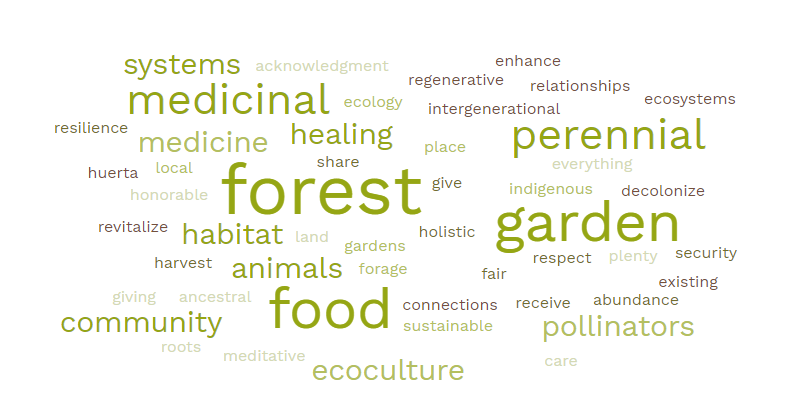
Forager’s Rule of Thumb:
As a community forager, you are a steward of this land. In this site you will be able to find and connect with many native, edible, medicinal, pollinator, and utilitarian plants. As a community we gently remind you to take less than ⅓ of a particular harvest so that collectively we can promote an ecologically sound environment. We are a large insect, animal, bird, and human community. Please be mindful that we all coexist and limit your harvest of one particular plant so that we may all benefit (including the plant!). This community permaculture site was designed to educate so that you can be equipped with additional information to plant these species in your own backyard/space and more easily identify and engage with them throughout the city. We hope you learn and enjoy the El Paseo Permaculture Site!
Thank you
This project was made possible by the 2018 Comed Green Region Grant, 2019 Openlands Treeplanters Grant, and a Country Financial Sponsorship.
Special thanks to lead designer, Nina Lawrin, owner of loveren collections; Everyday Forage, and Co-Founder of the Permaculture Chicago Teaching Institute.
Thank you to our community of volunteers, and our partners listed below:







Huerta de Salud
LikeLike
Forest Garden
LikeLike
Ecocultural Site
LikeLike